 English
 Español

DetailsVideo
Application:
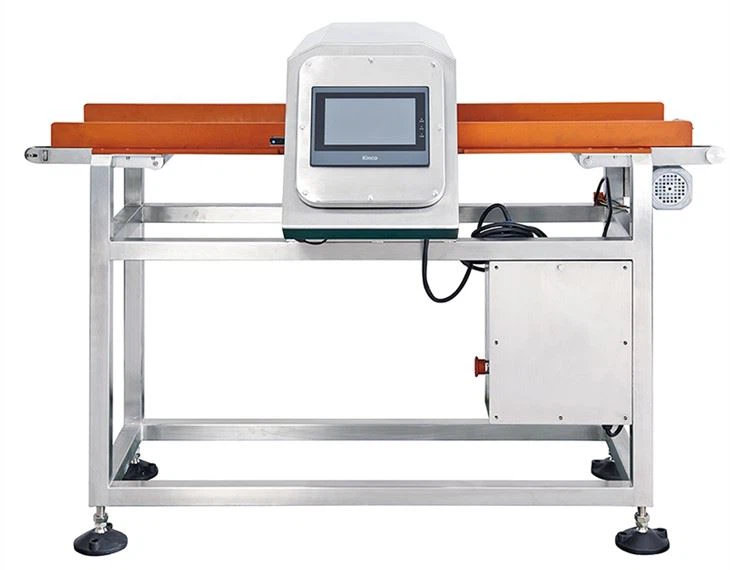
Metal detector for food industry can be used in food(meat, frozen meat, sea food, mushrooms, drinks ,fruits , sugar, salt and vegetables, snacks,spicy,etc), pharmaceutical, plastic, chemical, health products, cosmetics,textile, garment, hygienic products, electronics, renewable resources industry etc, applying to detect broken needles, iron wires, all kinds of metals (such as Ferrous,Copper,Brass, Aluminum,Stainless steel etc.) that mixed with products or raw materials.Our conveyor belt metal detector can be tested in bulk , bagged, bottled, boxed. Using metal detector can help relative corporations pass HACCP,GMP, QS, ISO9001 certificate.

Technical parameters:
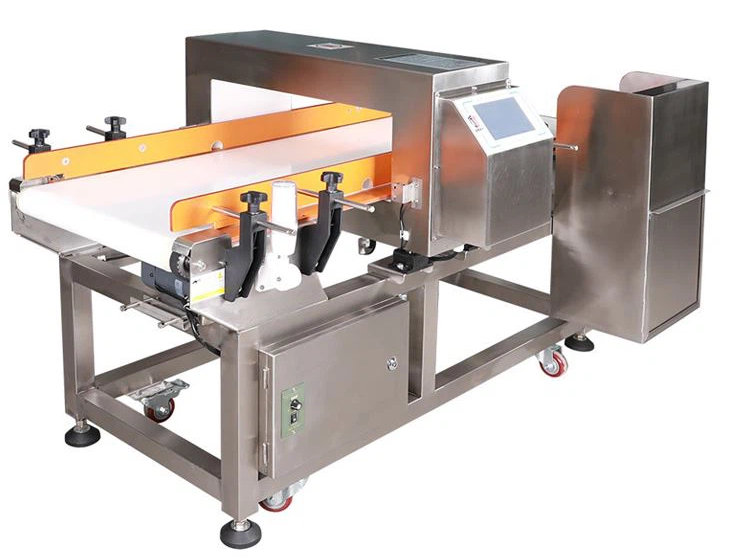
Detecting Tunnel Width:50mm* Height 20mm ( Customized)
Power supply: single phase, 220V, 50 HZ(standard) or as your required
Preset Number: 1-100 items
Operating temperature: 0℃~50℃
Standard reject system: Belt stop,sound and light alarm
Speed: 10-40m/min adjustable
Flow direction: usually from left to right
Whole conveyor length: 1500mm or customize
Conveyor to ground height: 750 +50mm or customized
Language: Chineses-English by default(Other languages customized)
Detecting Method :Electromagnetic Wave
Sensitivity: FeΦ0.8mm, CuΦ1.0mm, SusΦ1.8mm
Construction Material :304 SUS ( 316 SUS available)
Features:
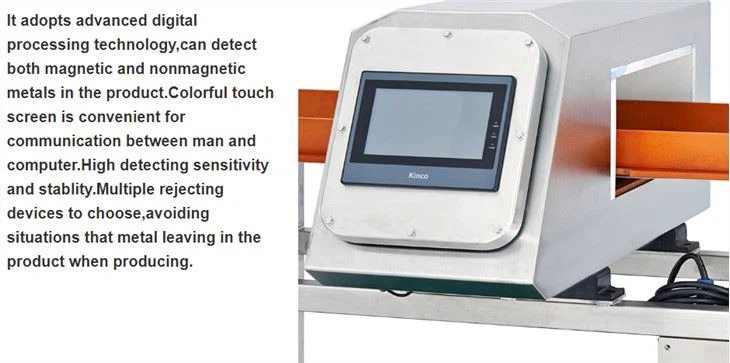
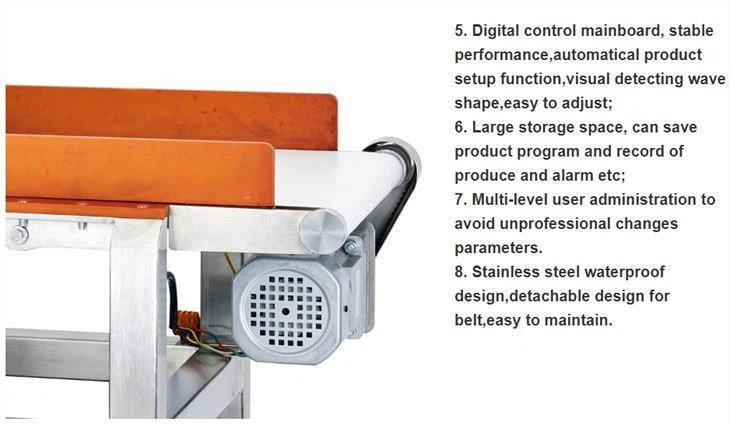
1.High sensitivity with great reliable performance
2. Phase-adapted technology can adapt products in order to effectively eliminate product effect.
3. A combination of DSP and Microprocessor is applied to process testing data of detection signals, which can enhance detection efficiency.
4. Easy to set up the detecting parameters.
5. Easy Operation.Self- learning function, can automatically learn and save the product's memory. Simple and easy operation with a touch screen.
6. Efficient.An automatic flap rejection system can improve production efficiency and save labor costs.
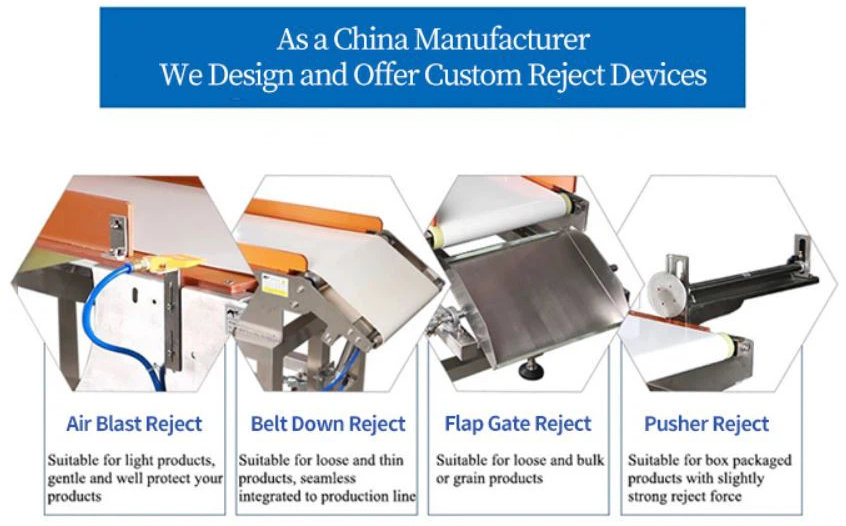
We can make different rejector devices on metal detector for industry according to your requirement.
Food safety is a top priority in the food industry. One of the critical aspects of ensuring food safety is using metal detectors to detect any metal contaminants that may have inadvertently entered the food processing system. However, not all metal detectors are the same, and not all foods require the same type of food metal detector rejectors.
Different types of foods have different characteristics that can impact the effectiveness of metal detection and the type of metal detector rejector required. For exmaple, for bulk food, it needs down rejector, for food in box with 1kg, it needs push rejector.
Metal detector for food industry are the equipment used to identify the presence of any metal particles in food products. The accuracy of such metal detector for food industry is of utmost importance as it ensures the safety and quality of the food products. However, there are several factors that may affect the accuracy of the food metal detector. In this blog, we will discuss these factors.
1) Type of food
Metal detector machine for food industry work on the principle of electromagnetic induction. The type of food product being checked can affect the accuracy of the metal detector. Some foods such as fruits and vegetables have high moisture content which can interfere with the signal of the metal detector, causing it to give false readings. Similarly, food products that contain high salt content can also affect the accuracy.
2) Environment
The environment in which the metal detector for food industry is used can also affect its accuracy. Factors such as temperature, humidity, and electromagnetic interference can affect the readings of the metal detector. For instance, if the temperature is too high or too low, it may interfere with the electromagnetic field, causing the detector to give false readings. Similarly, the presence of other electrical equipment in the vicinity can also interfere with the signal of the metal detector.
3) Size and shape of metal particles
The accuracy of the food metal detector is also dependent on the size and shape of the metal particles present in the food product. Smaller particles may not be detected by the metal detector, while the irregular shape of particles can cause interference with the electromagnetic field, leading to false readings.
4) Detector settings
The accuracy of the food metal detector can be affected if the settings of the detector are not properly configured. Different products require different detector settings depending on their size, shape, and composition. If the settings are not correctly adjusted, it can lead to inaccurate readings.
5) Operator error
Finally, human error can also affect the accuracy of the food metal detector. If the operator of the equipment is not properly trained or follows the correct procedures, it can result in inaccurate readings. For example, if the operator does not calibrate the metal detector correctly, it can lead to inaccurate readings.
Our Services
Pre-sales service:
1.We provide presales service in various forms, making investment budge, manufacturing, planning, so that customers can make a reasonable plan with less cost.
2.We will fist check customer's goods and goods size, then we will recommend suitable to 100% suitable.
3.We will recommend and offer machine according to customer's use and purchase budget.
In-sale service:
1.We will supply each manufacturing step photo for customer checking on time.
2.We will prepare packing and shipment according to customer's needing in advance.
3.Testing the machine and making video for customer's checking.
After-sale service:
1.We will guarantee the machine quality for 1years.
2.We provide free training and answer customer's question on technology in time.
Why the product passes industrial metal detection head, it alrms even if there is no metals? Now bestar give you some points.
1. The product passes the detection head and there is alarm even if there is no metal impurities, indicating that the detection parameters are not adjusted properly
2. Check whether the product has been debugged. If the detection product doesn't set, you need to re-adjust the detection parameters.
How we do if the industrial metal detection has no sensitivity?
1) Check whether there are large metal foreign objects in the hole of the probe head, such as coins, keys, screws, etc., and exclude metal impurities.
2) Whether the product selection is correct.
3) Whether it is selected in the NG prohibited state. In this state, the instrument will not perform any alarm or elimination action when detecting any metal, but the signal indicator will indicate.
4) If the above conditions are eliminated and the instrument still has no detection sensitivity, please call our company.