 English
 Español

DetailsVideo
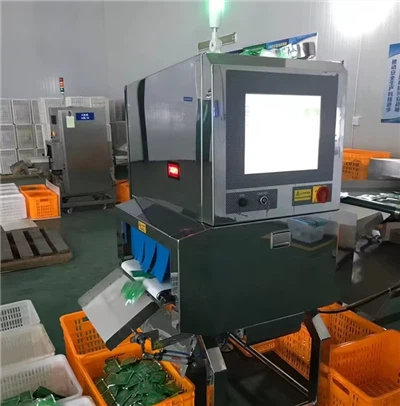
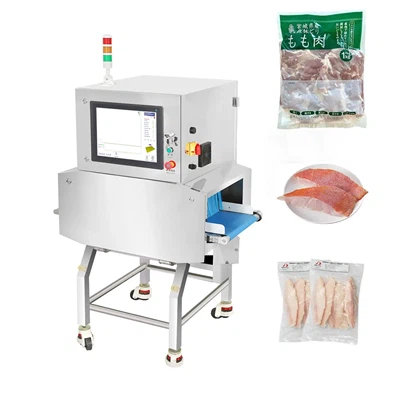
food x ray machine offer a great range of benefits including:
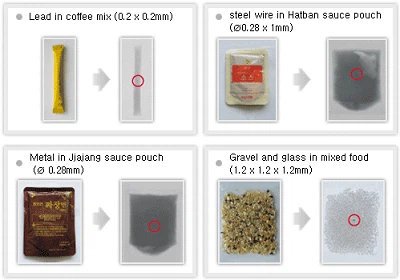
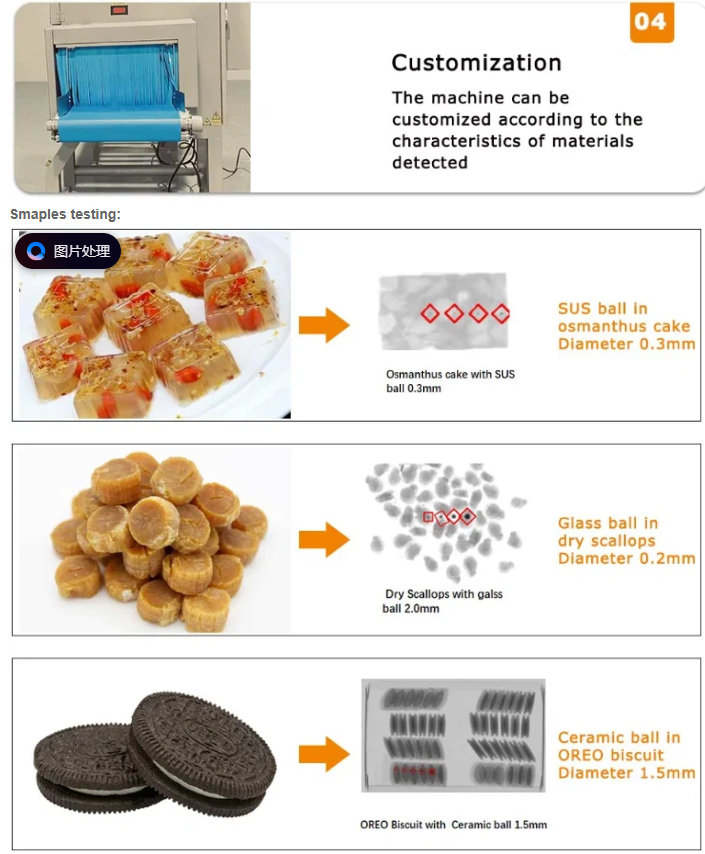
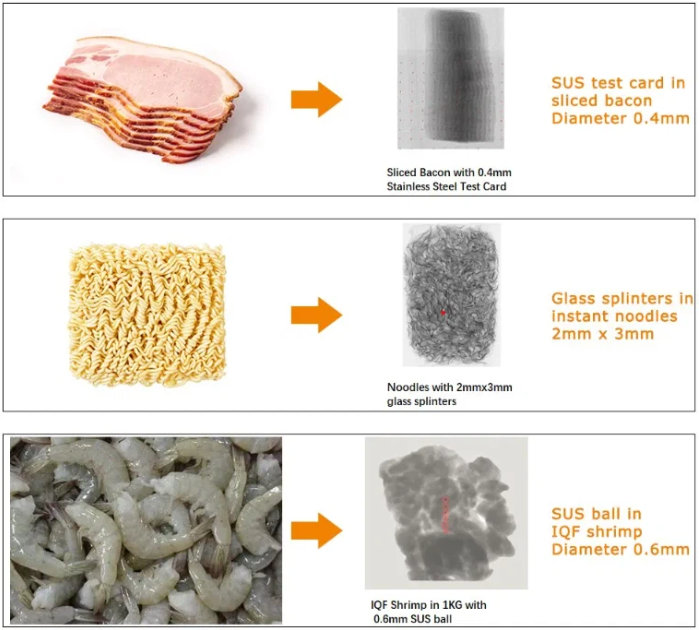
Detect a much wider range of contaminants Great detection of ferrous, non-ferrous and stainless-steel metal contaminants Reliable detection of glass, bone, ceramic/stone, dense plastics and product clumps, and other foreign bodies depending on relative densities of the contaminants Can reliably inspect products in aluminum trays or metallized foil packaging Can detect stainless steel and non-ferrous in food packed in metal foil or in aluminum trays without any interference from the packaging Check the integrity of products being scanned X-ray systems can simultaneously inspect for the product's, including missing items, excess products (by volume count), and x-weighing.
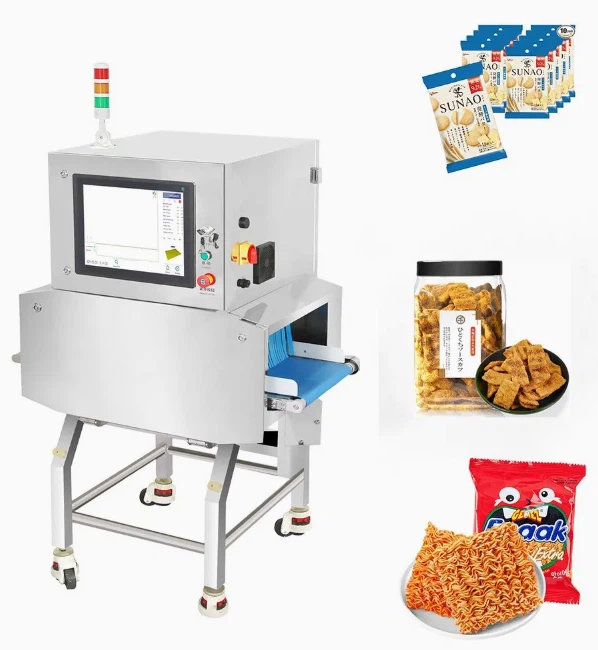
Technical parameter:
Model | ND300 | ND400 | ND500 | ND600 |
X-Ray Generator | 40-100kV (Adjustable) | 40-100KV | 40-120KV | 210W/480W/40-100KV |
Inspection Width | 300mm | 400mm | 500mm | 600mm |
Inspection Height | 150mm | 200mm | 250mm | 300mm |
Non-load Inspection Sensitivity | Stainless steel ball Φ0.3mm | Stainless steel ball Φ0.3mm Stainless steel wire Φ0.2*2mm Ceramics Φ1.0mm Glass Φ1.0mm | Stainless steel ball Φ0.4mm Stainless steel wire Φ0.2*2mm Ceramics Φ1.0mm Glass Φ1.0mm | Stainless steel ball Φ0.4mm Stainless steel wire Φ0.2*2mm Ceramics Φ1.0mm Glass Φ1.0mm |
Key Features:
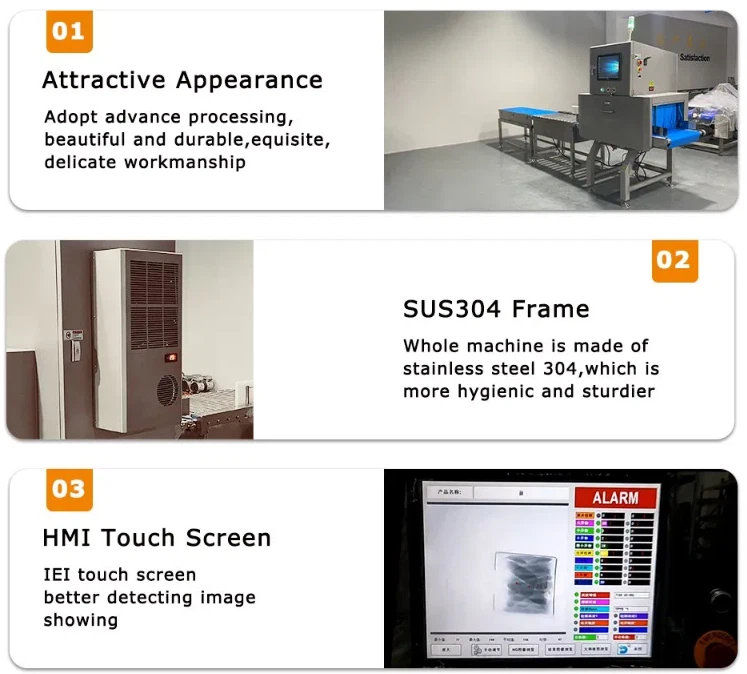
*Shielding function: Users can choose to biock the parts that do not need to be detected, such as aluminum fim packaging,desiccant, detection object boundary. aluminum buckle, etc.
Delect detection: In addition to foreign object detection, the x-ray inspection system can also detect and count missing items and broken products.
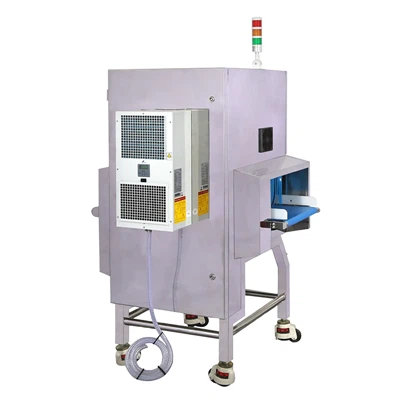
Strong environmental adaptability: With a independent air supply tor light source, the x-ray inspection adapts to various environments, even some extreme environments. The ambient humidity can reach 90%, and the ambient temperature can reach -10~40°C.
Strong air conditioning performance: The circulating pipe cooling system can prevent condensation at low temperatures and cool down at high temperatures. This kind of design can also enhance product life and more stable performance.
Remote Support: In the event of operational problems or machine failures, users can use the built-in software of the fuselage. Our after-sales team can remotely assist in solving the issues and improve efficiency.
More details:
Who buy your food x ray machine?

Before offering food x ray machine, could you kindly answer our questions as below? So that we can find the most appropriate machine for you and send its quotation to you.
1. Product Type: What kind of product will you be packaging? (e.g., powder, granules, liquids, snacks, frozen food)
2. Package type: what is the material of your package, and the package size?
3. Weight Range: What is the weight per package ?
4. Packaging Speed: How many packs per minute do you need?
What Factors That Affect Sensitivity of Detection for X-ray inspction Systems
There are several factors affect sensitivity of contaminant detection. These include:
The type of product – homogeneous packs are the easiest type of product to inspect via x-ray technology because of the product consistency. However, many food packs comprise areas of varying absorption caused by variable product amounts, gaps or air pockets which affects detection.
High density variations – some foods, such as granola with clusters of fruit and trail mix, contain high variations in density. Finding physical contaminants in these products can prove challenging for traditional single energy detectors as the varying densities create 'busy' x-ray images. However, x-ray systems equipped with dual energy x-ray technology lend themselves to inspecting 'busy' x-ray images caused by products with high variations in density due to their ability to discriminate materials by their chemical composition.
The thickness/depth of the product – as the density and thickness of the product increases, more x-ray energy is required to penetrate or pass through it. Increasing the x-ray penetration power (kV) reduces the contrast created by the contaminant which, in turn, reduces sensitivity. As the product depth increases, more x-ray energy is required to penetrate it.
The speed line affects detection – as production line speed increases, the signal to noise ratio also increases due to less integration time on the detectors. This means for faster lines you need more x-ray energy or larger detector pitch to achieve a certain result.
How Does X-ray Inspection Work?
X-rays belong to the group of gamma rays which are one of several naturally-occurring sources of radiation and are an invisible form of electromagnetic radiation like radio waves. All types of electromagnetic radiation are part of a single continuum known as the Electromagnetic Spectrum. The spectrum is arranged according to frequency and wavelength and runs from radio waves at one end (which have a long wavelength) to gamma rays at the other (which have a short wavelength). The short wavelength of x-rays enables them to pass through materials that are opaque to visible light, but they do not pass through all materials with the same ease. The transparency of a material to x-rays is broadly related to its density – the denser the material, the fewer x-rays that pass through. Dense contaminants like glass, calcified bone and metal show up because they absorb more x-rays than the surrounding product.
An x-ray system is essentially a scanning device. When a product passes through the system, it captures a greyscale image of the product. The software within the x-ray system analyses the greyscale image and compares it to a predetermined acceptance standard. On the basis of this comparison, it either accepts or rejects the image. In the case of a rejection, the software sends a signal to an automatic reject system which removes the product from the production line.